

 by
by Last Updated on December 4, 2025 by Avia
If you’re a precognitive, psychic, intuitive, empath, medium, gifted with ESP, highly sensitive, or hyper-aware, this post is for you. How many times have you assessed a situation from your unique position of non-physical, non-linear understanding, only to be summarily dismissed? Let’s say you observe something based on knowledge from your spirit guides, your intuition, so-called “dead” people, astrology, or non-local energy. Next, you express this observation to someone, only to be met with complete rejection, dismissal, or even outright ridicule. Has this happened to you? Fact is, it does happen (sadly, a lot) and it chaps my hide. So, I thought I’d talk about it. It’s called “epistemic invalidation,” and it needs to be addressed.
I know I’m using a lot of freaky words to describe something that might seem fuzzy at first, but bear with me. I’ll break down what epistemic invalidation is, why it happens, and what to do about it. If you consistently receive accurate information from unconventional, unorthodox sources and feel your wisdom is being ignored, shunned, or underestimated, stick with me. I think you’re going to relate to some thoughts I have & maybe even fall in love with the advice, tips, and experiences I’m going to share with you here. Ready to rock? Ok, let’s roll.
What Is Epistemic Invalidation?
It’s a fancy-dan phrase that simply means your wisdom is being invalidated. Put another way, it’s: People rejecting your reality because they don’t understand the way you know things.
If we break down the etymology (study of words & their meanings) of “epistemic,” we get this:
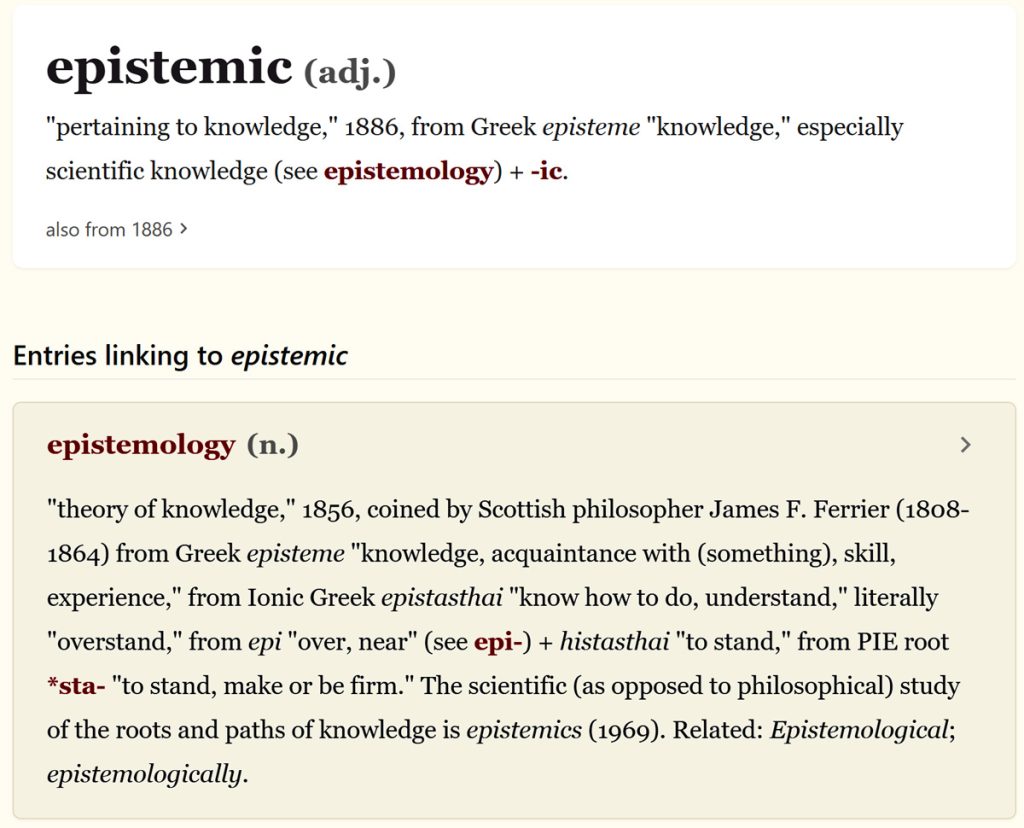
And invalidation? We all know what that is. It is when someone, something, a concept, idea, or point of view (POV) is considered not valid. Unworthy, lacks substance, devoid of value.
So, put the two together, and the meaning of epistemic invalidation simply means your knowledge or perspective is considered meaningless.
Why does this happen? I’ve got answers.
How & Why Does Epistemic Invalidation Happen?
In most cases, it’s b/c people can’t understand information the way a psychic would. People with clairvoyance, ESP, mediumship skills, intuition, highly attuned awareness, etc., interpret things differently than most. In reality, most people prefer the logical or easily explainable answers. They like the “1+1=2” process of identifying the reasons for things.
For empathic-intuitives, 1+1=2 logic doesn’t really compute. We have a more sensory, “big picture” absorption of data that doesn’t track with what might be explained in a news feed online, or a textbook. Hence, it’s considered logic or understanding that is “unconventional” or worse, it’s knowledge that has no foundation at all.
This is utter nonsense. I daresay that psychic knowledge poses far more foundation than knowledge gained from other so-called “reliable” or acceptable sources. After all, intuitive impressions are from a greater, grander source…channeled from a higher frequency that has a cosmic view. Alternatively, a CNN news report is a more linear, narrow source of information. Just saying.
Now, I’m not talking about information gleaned from a scientific or research-based standpoint. For instance, the atomic weight of cobalt is 58.9. That’s a fact that is measured and holds up. It’s not intuitive information.
I’m talking about observations related to human events that can be explained in multi-faceted ways. -Not just through newspapers, political agendas, or “it’s always been this way” kind of explanations. But answers that come from energetically primal or preternatural knowing…from sources that are divine, intuitive, channeled, or even otherworldly. And of course, to some, that sounds totally preposterous, and that’s why psychics & empaths so often encounter epistemic invalidation.
Examples of Epistemic Invalidation
Sadly, I have so many personal examples of epistemic invalidation that I could write a book. Since I was a tot, I had access to non-local information that, almost invariably, proved true & accurate. However, it didn’t take me long to understand that my source of knowing isn’t conventional, and therefore, I was often the brunt of endless ridicule, bullying, and admonishment from others. Consequently, I began to keep my insights to myself.
As I got older, however, I gained retrospection. I began to see my insights prove to be (however unorthodoxly obtained) valid, valuable, and trustworthy. But alas, to this day, I’m still met with consistent epistemic invalidation; I just handle it differently (I’ll get into that in a bit). Let me give you some examples:

1. When You Sense a Person’s True Intentions & Someone Tells You You’re Overreacting.
Intuition: You get a gut hit that someone is lying, hiding something, or manipulating the situation. Your body says nope.
Conventional Thinker’s Response:
“Well, I didn’t see any proof. You’re being dramatic.”
“You’re reading too much into it.”
“Stop being paranoid.”
Result: Your lived perception, the thing you’ve honed for decades, is dismissed as emotional noise. Grrr.
2. When You Know Something Is About to Go Wrong, but No One Believes You Until It Happens.
Intuition: A sudden shift in energy, a dream, a premonition, or just a bone-deep sense that something’s “off.”
Conventional Thinker:
“Calm down. There’s no evidence of that.”
“You always make everything dramatic.”
Outcome: The disaster unfolds exactly as you felt it would, and yet they forget they dismissed you.
3. When You Perceive Collective Tension (Full Moon, seasonal shifts, astrological events) and Someone Says You’re Just Being Woo-Woo.
Intuition: Your emotional barometer picks up a spike in weirdness. You feel pressure in the air. Everything in your life (and others’) gets glitchy. You understand from an empathic stance that something’s up (and maybe about to pop), but…
Conventional Thinker:
“It’s just politics.”
“People are nuts these days.”
“The moon doesn’t do anything.”
What This Misses: Solar cycles, circadian effects, emotional contagion, magnetic fields, seasonal depression, animal behavior shifts, all measurable, but ignored because it sounds “mystical.”
4. When You Know a Relationship Is Over Before Anything Outward Happens.
Intuition: You feel the withdraw, the energetic unplugging, the disconnection.
Conventional Thinker:
“But they didn’t say anything!”
“You’re imagining problems.”
Outcome: Three weeks later, the breakup. And they act like it came out of nowhere.
5. When You Sense Someone Is in Trouble Before They Tell You.
Intuition: Your body tightens. You suddenly think of them intensely. Your dreams or symbols point to them.
Conventional Thinker:
“You can’t know that.”
“That’s coincidence.”
Reality: You find out later something did happen, at the exact moment you felt it.
6. When You Understand Someone’s Emotion Before They Express It
Intuition: Empathic reading: you feel their sadness, fear, guilt, or joy instantly.
Invalidating Response:
“They seemed fine to me.”
“You’re projecting.”
But You Were Right: They break down later, or confess they were struggling.
7. When You Know a Decision Is Wrong Even If All Data Says It’s Right.
Intuition: A job offer looks perfect. Top salary, benefits, prestige. But your soul screams “no.”
Conventional Thinker:
“You’re being unrealistic.”
“You need to follow facts, not feelings.”
“You’re just jealous.” (that’s the worst)
Outcome: The job becomes a toxic time-suck, and you walk away thinking, “Damn…I called that.”

8. When You Pick Up Someone’s Lies Without Evidence.
Intuition: Their tone, microexpression, or energetic field shifts. You feel the distortion.
Invalidation:
“You can’t accuse someone without proof!”
“You’re suspicious of everyone.”
Later: Proof arrives, and suddenly your “paranoia” looks more like discernment.
9. When You’re Right About a Health Issue Others Can’t See Yet
Intuition: You know something’s wrong in your body, or someone else’s. You feel an imbalance before tests show anything.
Invalidation:
“Everything looks normal.”
“You’re being dramatic.”
Outcome: A diagnosis emerges months or years later. Exactly what intuition warned.
10. When You Sense Big Life Shifts Before They Manifest
Intuition: A relationship ending. A move. A job change. A death. A financial shift.
Invalidation:
“You can’t predict the future.”
“You’re catastrophizing.”
“That’s just anxiety.”
But you find out later, you were perceiving early tremors of big shifts ahead.
11. When You Offer Insight, and Someone Immediately Reframes Reality in Their Own Limited Lens
You: “There’s something deeper happening here…collective tension, emotional saturation, cosmic influences.”
Dismissive Person:
“No. It’s these damn liberals/republicans/immigrants/the economy/traffic/whatever.”
This is classic epistemic invalidation: They narrow the frame down to what they trust (facts, fear, politics) while discarding your broader perspective.
12. When You See Patterns in People or Situations That Others Can’t Yet Connect
Intuition: You see the pattern forming, like lines in a constellation.
Invalidation:
“You’re overthinking.”
“Don’t jump to conclusions.”
But patterns do reveal themselves later, just not early enough for conventional thinkers to recognize them with you.
13. When You Know the Emotional Temperature of a Room the Moment You Walk In
Intuition: You read the field instantly: stress, excitement, resentment, grief, tension, joy
Invalidation:
“I don’t know what you’re talking about. Everything seems normal.”
“You’re too sensitive.”
Outcome: Within 10–20 minutes, someone blows up, breaks down, or spills the truth.
14. When Your Symbolic or Shamanic Understanding Is Treated as Inferior to Literalism
Intuition: You perceive meaning in animal encounters, dreams, synchronicities, signs.
Conventional Thinker:
“It’s just random.”
“You’re reading too much into things.”
Reality: Your empathic literacy often reveals emotional or spiritual truths others can’t access.
So, What Can You Do?
I tell you folks, if I had a dollar for every time I heard the “conventional thinker” respond to me in the same or similar ways you just read in these 14 examples of epistemic invalidation…Well, I wouldn’t be working three jobs as I am now, that’s for sure! #11 is a particular recurring pattern in my life. So, what can we do about it? I’ve got ideas.

Stop Explaining Yourself to People Who Are Incapable of Hearing You (much less, understanding you)
This is the most freeing shift you can make.
Some people will never entertain intuitive ways of knowing because it threatens their worldview. Explaining yourself becomes self-betrayal.
What to do instead:
- Say less.
- Smile inwardly.
- Honor your knowing privately.
Internal mantra:
My intuition doesn’t need permission to exist.
Build an Inner “Council of Trust”
This is a mental shift you must cultivate.
When your intuition gets dismissed, immediately recall:
- The times you were right.
- The situations where you “knew” before anything was visible.
- The warnings you felt that later proved valid.
I’m not suggesting this as a way to validate yourself to others. However, it’s good to recall the moments when your intuitive instincts were on target, so perhaps you don’t feel discounted if you’re met with epistemic invalidation.
Set a Hard Boundary Around Certain Topics
Not everyone gets access to your deepest knowing.
If you know someone will dismiss you:
- Do not bring up intuitive insights with them.
- Speak only about practical, neutral topics.
- Save your wisdom for safe people.
If this one is a toughie for you, take a look at my tips about setting boundaries as an intuitive-empath in service.
Reframe Their Dismissal as a Limitation of Their Lens, Not an Error in Yours
When someone dismisses you, remind yourself: They’re not rejecting truth. They’re rejecting anything outside their cognitive comfort zone.
Conventional thinkers only trust:
- Proof
- Data
- Patterns after the fact
- Tangible events
Practice “Strategic Silence”
I love this one, and it’s often my fall-back response. It’s one of the most powerful tools available.
You don’t have to counter, defend, or argue. You don’t even have to explain yourself.
You also don’t have to agree.
You can simply say:
- “Interesting perspective.”
- “I see it differently.”
- “I hear you.”
- “Let’s revisit this later.”
- “You might be surprised.”
Let Your Intuition Redirect Your Behavior Without Announcing It
One of the biggest mistakes intuitives make is trying to justify their knowing.
You don’t have to explain your reasons to act on your wisdom.
You can simply act.
Examples:
- If you sense danger, leave. You don’t have to explain the vibe.
- If you feel someone can’t be trusted, take distance. You don’t owe a thesis.
- If you sense a relationship is done, withdraw. Full stop. Your knowing & clarity is enough.
Develop Stock Responses That End the Conversation Gracefully
These help you stay grounded when confronted with someone who’s trying to invalidate you.
Try these:
- “I’m not asking you to believe it. I’m sharing my experience.”
- “My intuition has earned its credibility.”
- “You don’t have to understand it for it to be true.”
- “We have different ways of seeing things.”
- “Let’s agree that we interpret things differently.”
- “Trust me on this one.”
- “I’m not debating. I’m simply stating what I know.”
I came up with these responses primarily from being inspired by what the character Morpheus said in the Matix movie, which was:
“My beliefs do not require your belief in them.” (or something to that effect) ~Morpheus, the Matrix
Protect Your Confidence by Reducing Exposure to Habitual Invalidators
We all have those folks in our lives that we, for whatever reason (family, co-workers, semi-BFF’s), we have to interact with. If your someone always dismisses your insights, try these tips:
- Reduce emotional intimacy.
- Limit your topics with them.
- Interact only in practical or surface-level ways.
As an empath, habitual invalidators can be dangerous to your self-esteem. But you don’t have to cut them out of your life. Simply relocate them, yourself, and/or the dialogue. Redirect. You’re clever, you know how.
Trust the Timing: Intuitives Are Often “Right Too Early”
Pattern recognition on a spiritual, emotional, and energetic level is how many intuitives perceive things. That kind of recognition doesn’t work by “clock” time, and it’s not linear. Because you know things before they bloom on the physical plane, your insights might be misconstrued or misunderstood. Reassure yourself that time is ephemeral, and doesn’t work in the structured way most conventional thinkers would prefer. So, when someone says you’re wrong, tell yourself:
“No, I’m early.” or “Soul timing is always on time.”
That single reframing can save years of self-doubt, trust me on this.

When Someone Dismisses You, Do a Quick Internal Check-In Instead of Spiraling
Questions to ask yourself:
- Does what I’m sensing feel calm or frantic?
- Is this a familiar intuitive feeling?
- Do I have a track record of being right about things like this?
- Does their dismissal come from fear, ego, or control?
- Does this insight serve me, even if no one else believes it?
Find At Least One “Intuition-Literate” Person
Everyone needs one. A friend, sibling, fellow intuitive, therapist, mentor.
Someone who says:
- “I believe you.”
- “I get it.”
- “That makes sense.”
- “Tell me what you’re feeling.”
It can be just one person. Sometimes it’s even your dog (I’d lose my ever-lovin’ mind w/out my dogs! They totally get my vibes & guard my psychic scenes).
Most Important: Do Not Absorb Someone Else’s Fear-Based Worldview
Many invalidators live in:
- fear
- cynicism
- rigid thinking
- political tribalism
- emotional illiteracy
Understand that, and concede that their dismissal likely has nothing to do with you. It’s simply a reflection of the prison of narrow thinking they live in. Your intuition threatens the walls around their worldview. That’s very often why admonishment happens…b/c they need to retaliate against the ideas that topple their apple cart (whether they know they’re doing it or not).
Last Words Before Climbing Off My Soapbox
Ultimately, epistemic invalidation is a real thing, and it’s a burden almost all intuitives are destined to bear. It’s how we respond to being dismissed, I think, is what counts on our long and winding road through life, seeing the world as we do. Easy? Nope. Doable? Yep.
Also, remember this. Because you are an intuitive-empathic sensor and thinker, you’re also inherently flexible. Lemme say it this way: because you think different, you also have the ability to respond differently. Your mind is nimble. You know about backdoors into solutions, alternate ways to see things. Consequently, you are fully equipped to handle naysayers with equal flexibility & aplomb.
Lastly, love yourself. Take care of yourself. Honor and respect yourself (even when it seems others are discounting you). Have your own back, and know your guides are in your corner too.
Well, folks, that’s all. Thanks for letting me get this off my chest. I hope in some small way these thoughts about epistemic invalidation (what it is, and how to handle it) were helpful to you. As always, thanks for reading!
Mighty brightly,

© Copyrighted. All Rights Reserved.
Release Your Inner Bodaciousness With These Amazon Selections by Jen Sincero