 by
by Last Updated on July 1, 2026 by Avia
Sapere Aude: What Does it Mean? Why is it Important?
Quick Answer: Sapere aude is a Latin phrase meaning “dare to know,” “dare to think for yourself,” or “dare to discern,” or “dare to be wise.” Popularized by the Roman poet Horace and later embraced by philosopher Immanuel Kant, the phrase encourages intellectual independence, critical thinking, curiosity, and personal discernment. Today, sapere aude reminds us to question assumptions rather than simply accept what others believe.
Meaning of Sapere Aude at a Glance
| Topic | Answer |
|---|---|
| Language | Latin |
| Literal Translation | Dare to know |
| Common Meaning | Dare to think for yourself |
| Alternative Meanings | Dare to be wise • Have the courage to use your own reason • Dare to discern |
| Pronunciation | sah-PEH-reh OW-deh |
| First Recorded Use | Roman poet Horace (Epistles, Book I, Letter 2) |
| Popularized By | Immanuel Kant in his 1784 essay What Is Enlightenment? |
| Central Theme | Independent thinking, wisdom, discernment, intellectual courage |
| Often Associated With | Philosophy, the Enlightenment, education, symbolism, personal growth |
| Modern Uses | Tattoos, personal mottos, education, leadership, critical thinking, symbolic living |
What Does Sapere Aude Mean?
Sapere aude is a Latin phrase that literally translates to “dare to know.” Over the centuries, it has also been interpreted as “dare to be wise,” “dare to think for yourself,” and “have the courage to use your own reason.” Although these translations differ slightly, they all express the same enduring idea: true wisdom begins when you’re willing to question assumptions, seek understanding, and think independently rather than simply accepting what others believe.
When I adopted the phrase sapere aude as the motto for Whats-Your-Sign.com more than 13 years ago, I thought I was being pretty clever. I imagined I had stumbled upon an obscure Latin expression that perfectly captured the spirit of this website. Then I discovered I was in good company. The Roman poet Horace first used the phrase more than 2,000 years ago, and centuries later Immanuel Kant famously embraced it as the rallying cry of the Enlightenment. Since then, sapere aude has inspired philosophers, educators, artists, and curious minds who believe that genuine understanding requires courage as much as intelligence.
The beauty of sapere aude is that it resists being confined to a single translation. Latin is wonderfully nuanced, and every translator brings a slightly different emphasis to the phrase. Some prefer “Dare to Know.” Others favor “Dare to Be Wise” or “Have Courage to Think for Yourself.” None of these interpretations is wrong. Instead, each shines a light on a different aspect of the same philosophy: pursuing truth through curiosity, reason, and personal insight.
Historical Note
Although Horace coined the phrase, Immanuel Kant transformed it into the philosophical motto of the Enlightenment.
My high school Latin teacher, after three years of introducing us to the richness of the language, translated sapere aude as “Dare to Discern.” That interpretation has stayed with me ever since, and it’s the one I’ve chosen to embrace. For me, discernment is more than acquiring knowledge—it’s learning to recognize what rings true after thoughtful reflection. It’s the ability to weigh ideas carefully, separate wisdom from noise, and discover meaning through your own experience.
That philosophy is woven into nearly every article on this website. When exploring signs, symbols, dreams, animal meanings, or spiritual experiences, I don’t want you to simply accept my interpretations—or anyone else’s. My years of studying symbolism represent just one perspective in a vast ocean of history, mythology, culture, psychology, and personal experience. Even symbols that seem universally understood often carry very different meanings depending on the culture, historical period, or individual encountering them.
My hope is that these articles encourage you to think more deeply about the symbols that capture your attention and the experiences that resonate with you. Explore widely. Stay curious. Question respectfully. And above all, remember that your own thoughtful discernment is one of the most valuable tools you possess.
Sapere aude. Dare to discern.
Key Takeaway
Sapere Aude encourages people to seek wisdom by thinking independently rather than accepting ideas without question.

“Being your true self can only come from separating your thinking from crowd mentality.”
~Edmond Mbiaka
What Does Sapere Aude Symbolize?
At its heart, sapere aude symbolizes the courage to seek truth, even when the answers aren’t easy or convenient. It’s about stepping beyond inherited beliefs, questioning assumptions, and trusting your own ability to recognize wisdom when you encounter it. In many ways, sapere aude is a way of moving through life with open eyes and an open mind.
From a symbolic perspective, this timeless Latin phrase is closely connected with themes of wisdom, awakening, discernment, transformation, and personal sovereignty. It encourages us to become active participants in our own understanding rather than passive recipients of someone else’s conclusions. That simple shift can change the way we interpret not only ideas, but also the symbolic experiences unfolding around us every day.
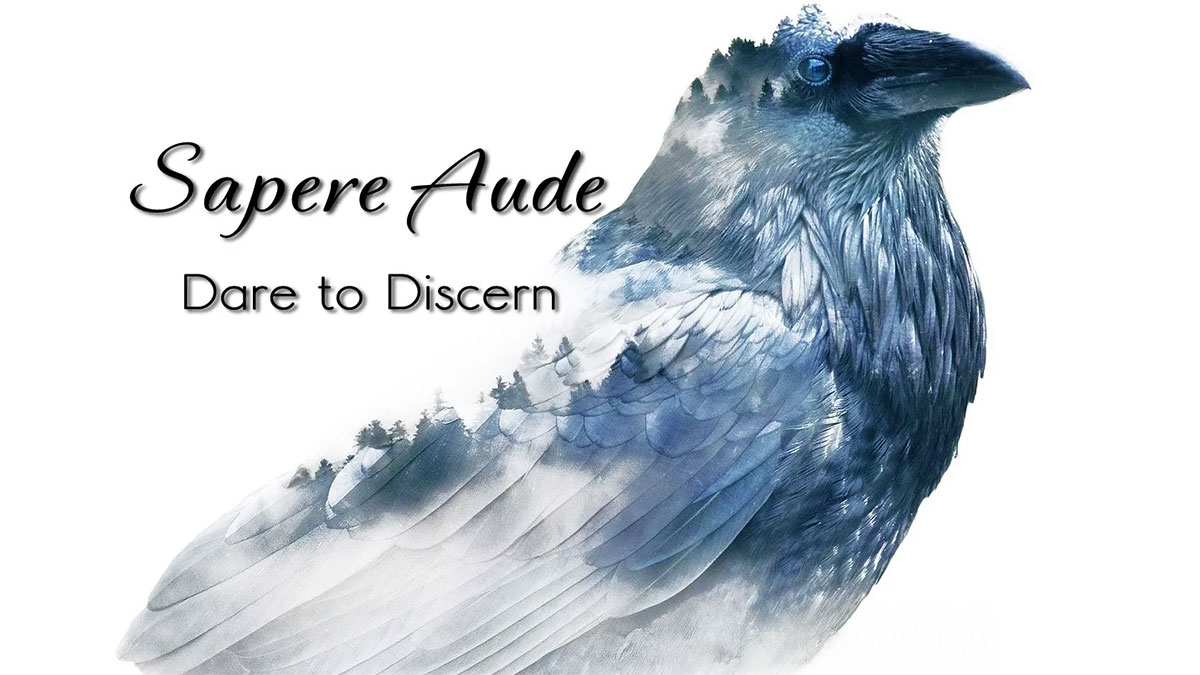
Throughout history, many traditional symbols have reflected this same journey of courageous awareness. Owls, for example, have long represented wisdom, insight, and the ability to see what remains hidden in darkness. Ravens and crows often symbolize intelligence, transformation, mystery, and the willingness to explore what others overlook. Light has almost universally represented knowledge, clarity, and truth emerging from uncertainty, while standing at a crossroads reminds us that every meaningful choice begins with careful reflection rather than blind acceptance.

For me, sapere aude also speaks to the symbolic process itself. Every meaningful sign, dream, animal encounter, recurring number, or synchronistic event invites us to pause and ask questions rather than rush toward easy answers. Sometimes the greatest insight doesn’t come from finding the “correct” interpretation—it comes from developing the wisdom to ask better questions.
That’s why I continue to embrace the translation “Dare to Discern.” Discernment isn’t simply gathering more information. It’s learning to recognize patterns, weigh possibilities, challenge assumptions, and trust the quiet voice of experience, intuition, and reason working together. To me, that’s where the deepest symbolic meaning of sapere aude truly lives.
Sapere Aude in Everyday Life
It’s one thing to admire the phrase sapere aude. It’s another to live it.
The symbolic meaning of sapere aude isn’t confined to ancient philosophy or Latin classrooms. It shows up in ordinary moments that quietly ask us to pause, think, and choose our next step with intention. Every day presents opportunities to practice discernment, and that’s where this timeless idea becomes truly powerful.
Living sapere aude means having the courage to question assumptions before accepting them as truth. It asks us to become curious instead of being reactive, to investigate rather than imitate, and to form our own conclusions rather than simply echoing the loudest voices around us.
Sometimes that courage appears when you’re facing a difficult decision. Perhaps you’re deciding whether to leave an unfulfilling career, end a relationship that no longer supports your well-being, or pursue a path that others don’t understand. Sapere aude reminds us that meaningful choices aren’t always the easiest ones, but they should be made thoughtfully rather than fearfully.
The same principle applies to relationships. Discernment encourages us to look beyond appearances, communicate honestly, recognize unhealthy patterns, and resist making assumptions about other people’s intentions. Wisdom often begins not with having all the answers, but with asking better questions.
For many people, sapere aude also becomes a deeply spiritual practice. Rather than accepting beliefs simply because they’ve been handed down by tradition or authority, it invites respectful exploration, personal reflection, and a willingness to discover what genuinely resonates with your own experience. Seeking truth asks us to engage with it thoughtfully and authentically.
This philosophy lies at the very heart of symbolic interpretation. Whether you’re exploring dreams, recurring animal encounters, meaningful coincidences, or the language of signs and symbols, the goal isn’t to memorize someone else’s definitions. It’s to thoughtfully consider history, culture, intuition, personal experience, and context before arriving at your own understanding.
In the end, that’s why sapere aude continues to inspire me. Every symbol is an invitation. Every question is a doorway. Every meaningful experience offers another opportunity to practice discernment, deepen your understanding, and discover wisdom that is uniquely yours.
Why Is Sapere Aude Still Relevant Today?
You might think a Latin phrase coined more than two millennia ago would have little to say about modern life. I would argue the opposite. If anything, sapere aude has become even more relevant in an age where we’re constantly surrounded by information, opinions, algorithms, and endless streams of competing voices.
Today, we’re expected to make sense of news headlines, social media debates, viral videos, AI-generated content, advertisements, and advice from complete strangers, all before we’ve finished our morning coffee. Information has never been more abundant, but wisdom still requires something slower and more intentional: discernment.
That’s exactly where sapere aude shines.

The phrase reminds us that critical thinking isn’t about automatically rejecting ideas or distrusting every source. Rather, it’s about having the patience and courage to ask thoughtful questions, evaluate evidence, consider different perspectives, and arrive at conclusions with both reason and integrity. Discernment is the practice of seeking truth with an open mind.
Artificial intelligence has made this lesson even more important. AI can summarize information, generate ideas, and help us explore unfamiliar topics, but it cannot replace human judgment, lived experience, intuition, or personal responsibility. Whether you’re reading a book, browsing social media, using an AI assistant, or interpreting a meaningful symbol, the final responsibility for what you believe (and how you act upon it) still belongs to you.
That, to me, is the enduring gift of sapere aude. It reminds us that wisdom isn’t measured by how much information we consume, but by how thoughtfully we examine it. Every conversation, every experience, every symbol, and every challenge offers another opportunity to practice discernment.
More than 2,000 years after Horace first penned these words, sapere aude continues to offer the same timeless invitation: be curious, think deeply, seek truth, and have the courage to trust your own well-reasoned judgment.
An Additional Note About Sign and Symbol Meanings
Signs and symbols cultivate their meanings according to culture, context, passage of time in society as well as mass societal opinion. What’s cool and highly important is that signs and symbols earn their most powerful meanings from our own personal perspectives.
This website strives to provide you with the best, time-honored information when defining signs and symbols. However, in the final analysis, “Beauty (and symbolism) is in the eye of the beholder.”
Having said that, it’s in our best interest to invest the time in personal research into symbolic events happening to us. This website is just one perspective in an ocean of variety and diversity in the realm of symbolism. So dive in! There is a whole universe of deeper meanings to explore! You can start your research by clicking on the links at the end or to the side of this page. Odds are good I’ve got a follow-up article about this symbolic topic. 😉
As always, thanks for your willingness to learn more about the language of symbolism. It’s a language that is universal and everywhere. It’s super-groovy to travel with you on your symbolic path, and maybe offer a little translation along the way. Thanks for reading and exploring! And remember – sapere aude – dare to discern!
Mighty brightly,

© Copyrighted. All Rights Reserved.
Other Articles of Interest on This Website

Symbolic Meaning of Choice
Have you ever considered your choices are symbolic? I think they are, and that’s why I wrote this article on the symbolic meaning of choice. What if we can dig deeper into the meaning of our choices and get hard-core guidance from our findings? Check it out, I think you’ll be intrigued. Find out more about the symbolic meaning of choice here.

Interpreting Symbolic Meanings for Guidance
This article on using symbolism for guidance is a starting point-of-reference as you move through the symbolic pages on this website. It explains, very simply, how interpreting symbolism in our lives can lead to real, solid guidance. Get more about symbolism for guidance here.

Symbolism VS Superstition
Symbolism is an interactive practice and requires discernment. Whereas superstition is based on irrational assumptions. Get more about superstition vs symbolism and why it’s a pretty big deal here.