 by
by Last Updated on July 1, 2026 by Avia
St. Patrick’s Day symbols carry centuries of Irish history, mythology, and spiritual meaning. From the famous shamrock to the melodic Irish harp, these icons reflect the culture, beliefs, and folklore that shaped Ireland. In this guide, I explore some of the most recognizable St. Patrick’s Day symbols and their meanings, along with the fascinating stories behind them.
Table of Contents
Background Story on Saint Patrick
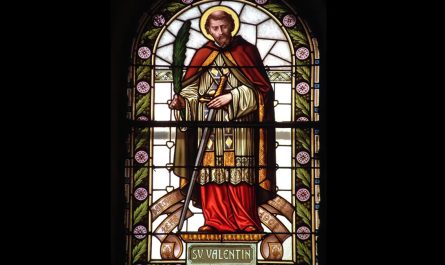
This Irish holiday is just as impressive with its symbolic meanings as well. Firstly, St. Patrick was a pretty remarkable dude…and he wasn’t Irish either. He was born around Roman Britain, close to Scotland. In a weird twist of fate, St. Patrick was captured by Irish raiders and made a slave in Ireland. Ironic, eh? Yeah…the guy who is an Irish icon was kept a slave there from the time he was 16. After about seven years as a slave, St. Paddy was called by God to serve a higher purpose, and he ran away from his dour life of slavery.
St. Paddy traveled Europe and got the education he lacked as a slave. Then God called St. Patrick again, telling him it was time to do great things in Ireland where he was held captive. So St. Patrick went back to Ireland to share his passion for Christianity. Talk about dynamic forgiveness! This is a guy captured by the Irish, yet he went back there as a missionary to talk about salvation.
St. Patrick didn’t have an easy time of it though. He made some big social blunders. On one occasion, Patrick lit a bonfire on what was then one of the most sacred Celtic celebrations (Beltane). No big deal, right? Well, the high Celtic king, Laoghaire saw Pat’s fire and was enraged. Apparently, it’s not good etiquette to light a bonfire before the king lights his own first. Oopsie. St. Patrick soothed over the hard feelings about the fire, started to make friends, and gained followers by sharing his views about Christianity.
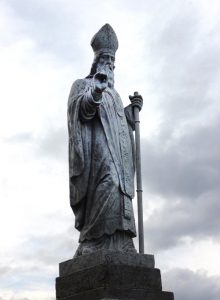
“I am imperfect in many things, nevertheless, I want my brethren and kinsfolk to know my nature so that they may be able to perceive my soul’s desire.”
~St. Patrick
What I find very cool about St. Patrick is that he took a different tact than many other missionaries. He wasn’t about crushing and converting the people. He actually meshed the Celtic/pagan beliefs with the Christian philosophy. So instead of obliterating Irish ancient beliefs, St. Patrick wove together the old and the new – forming a cohesion. He did this by taking time-honored symbols used by Irish country folk and using them to illustrate Christian concepts.
As he respected the old ways while honoring his own faith – I think St. Paddy would approve of this post on St. Patrick’s Day symbols. Why? Because symbols, either ancient or new, reflect an era, a culture, a belief, etc. Check out these St. Patrick’s Day symbols…I think you’ll find they make March 17th a little more rich with meaning.
Common St. Patrick’s Day Symbols
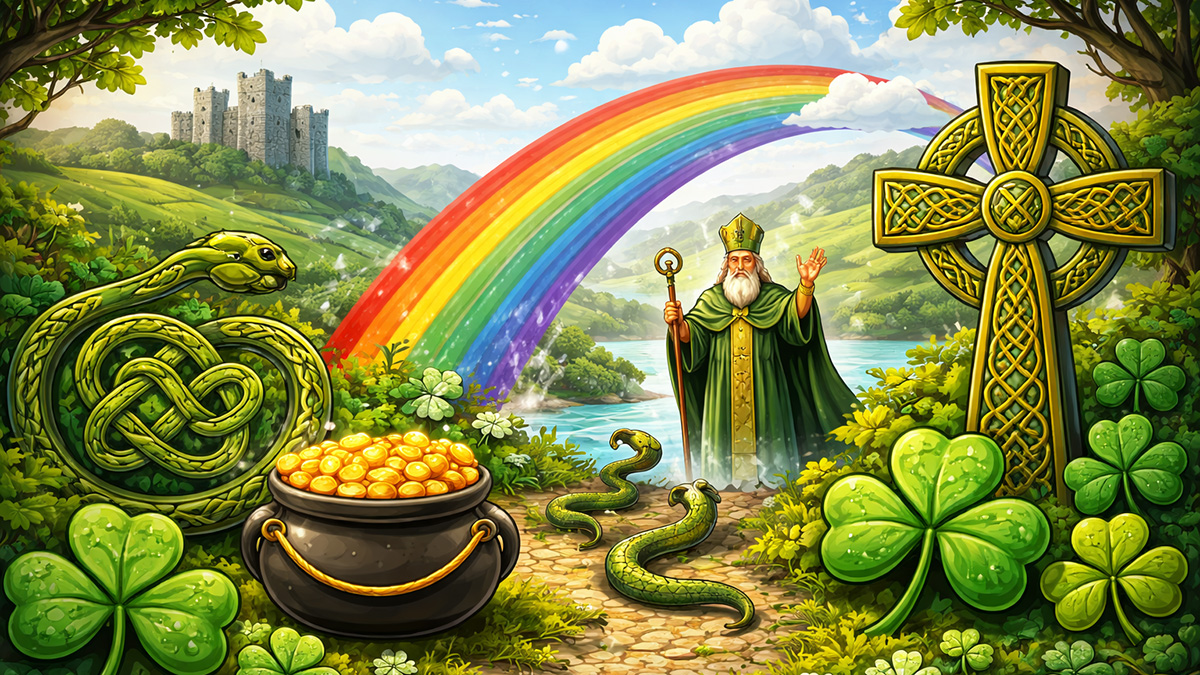
Before parades, green rivers, and festive gatherings took over the holiday, St. Patrick’s Day symbols carried deep cultural meaning rooted in Irish history, mythology, and spiritual tradition. Many of the icons we associate with March 17th today, like the shamrock, the harp, and even the mischievous leprechaun—began as meaningful emblems tied to faith, folklore, and national identity. Some of these symbols come directly from the life and teachings of St. Patrick himself, while others grew from Ireland’s ancient Celtic heritage and storytelling traditions. Understanding the common St. Patrick’s Day symbols and their meanings reveals how this beloved holiday blends legend, culture, and spirituality into a celebration recognized around the world.
Shillelagh

Okay, so it’s not the most sophisticated weapon, but certainly effective. Back in Patrick’s day, there was a lot of fighting for territory and feuding. The fighting Irish devised these clubs called shillelaghs from oak trees as weapons. Often, a warrior would double fist their clubs, one club in one hand to deliver the damaging blow, and the other club for staving off attacks. So what makes this one of St. Patrick’s Day symbols? Over time and with the evolution of St. Pat’s legend, the clubs turned into staffs or walking sticks. They were considered to be a mark of wisdom and great power. Check out almost any picture of St. Patrick, and you’ll see him with a staff – a mark of his esteemed position in the Irish culture.
Leprechaun
These are the wee ones in Irish lore. They are a group of fairies known as Luchorpan. They originally had a reputation of cobbling shoes. This is linked with the name which is Gaelic and means ‘one shoemaker’. Now, you’ve got to understand that in ancient cultures around the world, just about everything had a governing spirit (fairy, troll, goddess whatever). There is a hierarchy of mythic beings who are in charge of certain functions in life. Leprechaun’s, apparently were the Jimmy Choo of shoes back in the day. The leprechaun is included in this list of St. Patrick Day Symbols as a nod of respect to St. Pat for keeping old traditions intact. Rather than eliminating beliefs in magical beings, St. Patrick allowed the people to acknowledge them side-by-side with the new religion.
Harp
A national symbol of Ireland, the harp won popularity with the Irish long ago. Images of St. Patrick also feature a harp. Although he wasn’t born in Ireland, St. Patrick is a figure of the Emerald Isle and so the harp is also considered fitting among St. Patrick’s day symbols. This instrument was used in festivals, celebrations and just general family gatherings. Its music was said to put evil spirits to sleep and ensure peaceful dreams for children. The harp plays its way into Irish culture because it was custom for great tales and legends to be made into music. These tales were often sung accompanied by the harp. Telling stories through music was an essential part of early Irish heritage. In fact, one of the most ancient Celtic gods, The Dagda, had a magical harp he played to bolster his people in times of battle. Seeing as how St. Patrick is a living legend, it makes sense a few harp tunes were played in his honor. As a symbol of cultural heritage, St. Patrick and the harp go hand in hand.
Shamrock
This unlikely little plant set St. Patrick on the map. It is THE symbol he is most famous for. Why? Because St. Pat was a clever guy. He used the shamrock as a demonstration tool to explain the triple force behind Christianity (Father, Son, Holy Ghost). Celts were already digging the scene of triple energy (triple gods, and goddesses) when Pat showed up, so a trinity was easy to grasp. St. Patrick used the shamrock to show how each branch of the Christian faith stood on its own power, but all the leaves needed each other to live and grow. He used the leaves to explain the individuality of each holy entity, while also explaining their dependence upon each sacred power. Learn more about shamrock symbol meanings here.
Celtic Cross
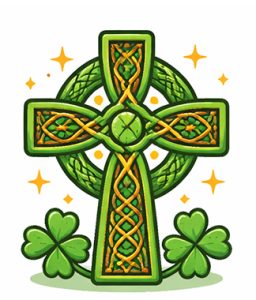
Among the many St. Patrick’s Day symbols, the Celtic cross always stops me in my tracks. It’s one of those symbols that quietly tells a big story about Ireland’s spiritual history.
If you’ve ever seen a Celtic cross, you’ll notice it looks like a traditional Christian cross, but with a circle connecting the arms. That circle is the key to its deeper symbolism. Many historians believe the ring represents the sun, a sacred symbol long honored by ancient Celtic cultures before Christianity arrived in Ireland.
This is what I love about Irish spiritual traditions. Instead of wiping out older beliefs, early missionaries often blended Celtic symbolism with Christian teachings. The Celtic cross became a bridge between these worlds. The cross represented Christian faith, while the circle honored ancient reverence for nature, the sun, and the cycles of life.
So when I think about the meaning of the Celtic cross as a St. Patrick’s Day symbol, I see it as a reminder that traditions evolve. It represents faith, cultural harmony, and the uniquely Irish way of weaving old wisdom into new belief systems.
Snakes
One of the most famous legends connected to St. Patrick’s Day symbols is the story that St. Patrick drove all the snakes out of Ireland.
According to the tale, Patrick stood on a hill and banished the serpents from the island forever. It’s a dramatic image, and it’s been told for centuries. But here’s where things get interesting: Ireland probably never had snakes in the first place.
After the last Ice Age, Ireland became geographically isolated, and snakes simply never migrated there. So if there were no snakes to banish, what does the legend mean?
Many scholars believe the story is symbolic. In early Christian storytelling, snakes often represented pagan beliefs or old spiritual traditions. In that sense, the tale of St. Patrick driving out the snakes may symbolize the spread of Christianity across Ireland and the gradual shift away from earlier religious practices.
Whether literal or metaphorical, the snake story remains one of the most enduring symbols associated with St. Patrick’s Day, reminding us how legends can carry deeper cultural meaning beneath the surface.
Green Color
Of all the St. Patrick’s Day symbols, the color green might be the most instantly recognizable. Every March 17th, everything from clothing to rivers seems to turn emerald.
But the connection between Ireland and green runs much deeper than holiday decorations.
Ireland is often called “The Emerald Isle,” thanks to its famously lush green countryside. The island’s mild climate and frequent rain create rolling hills and landscapes that stay vibrantly green throughout much of the year. Over time, this color naturally became associated with Irish identity itself.
Green also holds symbolic meaning connected to renewal and springtime, which aligns beautifully with St. Patrick’s Day taking place in March. Around this time of year, the earth is waking up again, plants are beginning to grow, and the landscape is shifting toward new life.
So when people wear green on St. Patrick’s Day, they’re not just joining a festive tradition. They’re celebrating the spirit of Ireland, the arrival of spring, and the vibrant life that both represent.
Pot of Gold
No list of St. Patrick’s Day symbols would feel complete without the legendary pot of gold at the end of the rainbow.
This playful symbol comes from Irish folklore surrounding leprechauns, those clever little tricksters who guard hidden treasure. According to legend, leprechauns stash their gold in secret places, and if someone manages to capture one, the tiny fellow must reveal where the treasure is hidden.
Of course, the pot of gold is almost always said to be at the end of a rainbow, which makes the treasure nearly impossible to reach. After all, rainbows move as you approach them, keeping their mythical riches just out of grasp.
I’ve always liked the deeper symbolism behind this story. The pot of gold represents luck, opportunity, and the hope of unexpected fortune. But it also reminds us that some treasures in life are meant to inspire us rather than be easily captured.
That blend of humor, magic, and possibility is exactly why the pot of gold remains one of the most beloved symbols of St. Patrick’s Day.
FAQs About St. Patrick’s Day Symbols & Their Meanings
The shamrock is easily the most recognizable St. Patrick’s Day symbol. According to tradition, St. Patrick used the three leaves of the shamrock to explain the Christian Trinity: Father, Son, and Holy Spirit. Because of this clever teaching tool, the humble clover became one of the most enduring symbols of Ireland and St. Patrick’s Day.
Green became linked with St. Patrick’s Day because Ireland is famously known as the “Emerald Isle.” Its lush green landscape inspired the color’s connection to Irish identity. Over time, green also became associated with Irish nationalism and cultural pride, making it the signature color worn during St. Patrick’s Day celebrations.
The Irish harp is the official national emblem of Ireland and has been a powerful symbol of Irish culture for centuries. Traditionally, harps accompanied storytellers and poets who shared legends, history, and folklore through music. Because of this deep cultural connection, the harp represents Ireland’s artistic heritage, storytelling traditions, and national pride.
Probably not, at least not literally. Ireland likely never had snakes after the last Ice Age. Many historians believe the story is symbolic, representing St. Patrick’s role in spreading Christianity and gradually replacing older pagan traditions. In this sense, the “snakes” may symbolize spiritual or cultural change rather than actual reptiles.
The pot of gold comes from Irish folklore about leprechauns hiding treasure at the end of rainbows. While it’s a playful legend, the symbol represents luck, hidden opportunity, and the idea that fortune may appear where you least expect it. It’s one of the more whimsical symbols connected with St. Patrick’s Day celebrations.
In closing, I hope you enjoyed this brief article on St. Patrick’s Day symbols and their meanings. To be sure, there are many more icons associated with St. Patrick, as well as Ireland. Don’t let your research stop here! Take some time to find out the symbolic meanings associated with this great time of year and the Irish culture. If nothing else, you can impress your friends at the pub with your knowledge about Irish symbolic history!
As always, thank you for reading. And I hope your St. Patrick’s Day (March 17th) turns out to be a frolicking good time.
Mighty brightly,
© Copyrighted. All Rights Reserved.
Weave the Ways of the Celts Into Your Life With These Celtic Symbol Amazon Selections
Other Articles of Interest on This Website

Shamrock and Four-Leaf Clover as a Good Luck Symbol
This article offers a lot of good luck symbols and their meanings. Included in this post is the meaning of the four-leaf clover and how it became so lucky. Click here for shamrock and other good luck symbol meanings.
Celtic Symbols and Meanings
For centuries, Celtic symbols and signs held incredible power for these ancient people in every way of life. Today, we can learn about this power and utilize it by learning the language of Celtic symbols. Click here for dozens of articles on Celtic symbols and their meanings.
Symbolic Meaning of the Shamrock
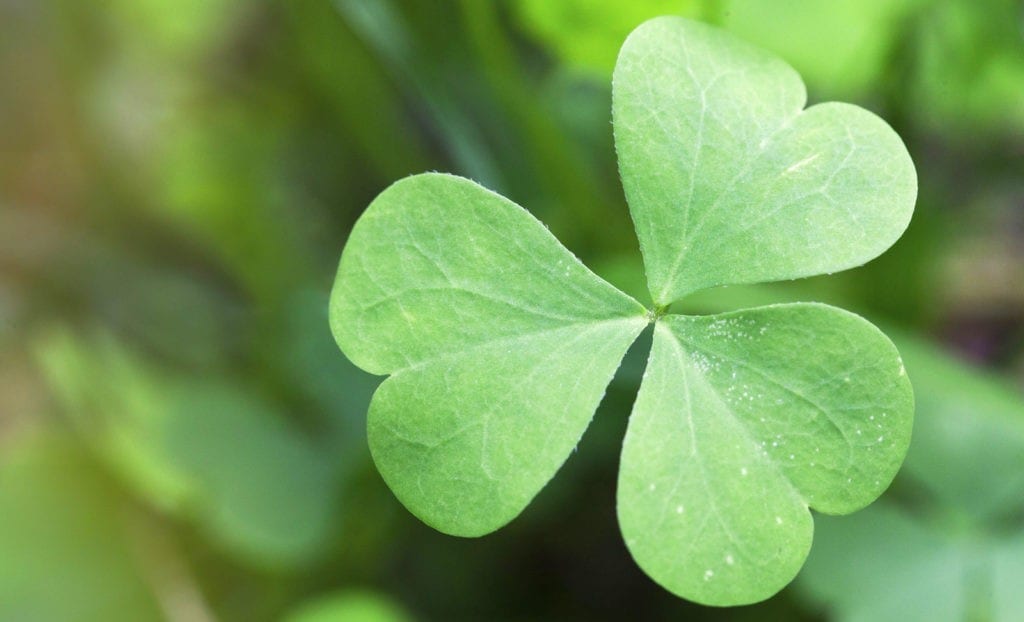
Symbolic shamrock meaning goes WAY beyond St. Patrick’s Day. But this article talks about why the shamrock is a big deal in Ireland. Click here for the symbolic meaning of the shamrock.